A Brief History of Johnstown Ohio.
Preserving our past, Embracing
our future.
Johnstown
lies in a section of Ohio originally designated as the U.S. Military
Tract. This area was set aside as a means of paying Revolutionary
War soldiers for their service. The land on which Johnstown sits
was originally deeded to John Brown, a veteran from Kentucky, but in
1810 he sold it to a New Yorker, Dr. Oliver Bigelow. Bigelow laid
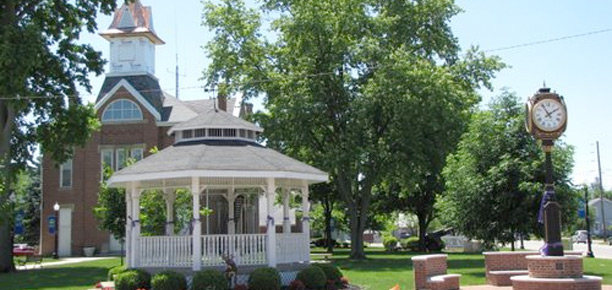
out the village in 1813, donating the streets and Town Square.
The first white pioneers in the vicinity, however, were a couple from
Virginia, George and Diadema Green, who arrived in 1806. Another
pioneer, George W. Evans, built the first cabin before the Greens were
able to do so. The area was part of Fairfield County until 1808,
when Licking County was formed. The principal origins of the
early settlers in Johnstown and Monroe Township were 1) south-central
and southwestern Pennsylvania, 2) the northern Blue Ridge section of
Virginia and present-day West Virginia, 3) the Mohawk Valley of New
York, and 4) Vermont, though smaller numbers came from other areas,
such as western Maryland. The makeup of settlers in Bennington,
Hartford, and Liberty Townships was similar, but Jersey Township
included a large group from northern New Jersey, and Vermont and New
York natives dominated St. Albans Township. Some of the streets
in Johnstown bear the names of these settlers: Pratt and Kasson
Streets, for example, were named after families from Pennsylvania.
Johnstown
grew slowly from its founding until 1880. It came to function as
the hub of Monroe, Liberty and Jersey Townships. The economy of
the area was based on agriculture, and thus many of the businesses in
the Village at the time served agricultural needs. Schools were
established early on, both in the Village and in the outlying
territory. Residents laid out local roads throughout the
countryside. The earliest churches established in Johnstown were
the Methodist Episcopal, Presbyterian and Baptist churches.
Although Johnstown contributed many soldiers to the Civil War, it never
became an important center of anti-slavery activity as, for instance,
Granville had. Toward the end of the nineteenth century, several
important changes occurred. Foremost was the construction of a
railroad in 1880. Other developments included the establishment
of a newspaper, the Johnstown Independent, the construction of the town
hall, and the installation of telephone lines. After the advent
of the railroad, growth accelerated. The town's population more
than tripled between 1880 and 1920, increasing from 278 to 906.
Most of this influx seems to have come from the surrounding rural areas.
The
first half of the twentieth century saw several important events.
Electric lights were installed in 1901. A major fire destroyed
the business section along Main Street in 1904, and as a result new
buildings were constructed of bricks. A town water system was
established in 1904. The school systems of Johnstown and Monroe
Township merged and, in the 1930's, a town sewage system was
created. However, the most celebrated event during this period
was the discovery of a nearly complete mastodon skeleton in 1926 on the
farm of Friend Butt, east of town near the current Bike Path
entrance. Numerous people came to view the excavation of the
skeleton. A Newark businessman bought the skeleton and
subsequently sold it to the Cleveland Museum of Natural History, where
it remains on display today.
Growth
leveled off after 1920, but increased dramatically after World War
II. The construction of Edwards Road spurred growth on the north
end of town. However, the largest boost came in the late 1950's,
when Courtesy Homes, Inc. built the Rolling Meadows development on the
west side of the Village. Johnstown's population more than
doubled from 1,220 in 1950 to 2,881 in 1960. Much of this growth
consisted of young war veterans of local origin who were seeking new
homes, but a significant portion was due to migration from West
Virginia and Kentucky. A number of industries located in
Johnstown after World War II, the most notable of which is the
Technical Rubber Co., now Tech International, on East Coshocton
Street. The new industries - together with the availability of
automobiles and the improvement of roads, which permitted commuting to
jobs in other locales - initiated another important change in
Johnstown: a movement away from its earlier economic dependence on
agriculture. Johnstown produced two U.S. Congressmen during the
twentieth century, William Ashbrook (served 1907-1921 and 1935-1940)
and his son, John M. Ashbrook (served 1961-1982). The former is
remembered most for his opposition to President Franklin Roosevelt's
New Deal policies and the latter for his anti-Communist stances.
Since
1970, rapid growth in the area has continued, but the some of the
growth has shifted from the Village itself to Monroe and adjacent
townships. There has been growth within the Village, though, such
as the Concord Crossing and Leafy Dell subdivisions and the development
of a new business district on the "Hill" on West Coshocton
Street. The origins of the newcomers have changes once again,
too. Now, most new residents who are not from neighboring
communities come from Columbus (especially the North End and
northeastern suburbs such as Westerville and Gahanna) or from northern
Ohio. A variety of new churches and service-oriented businesses
have appeared. With these changes, the economic transformation of
the community is virtually complete. Agriculture has faded
considerably, especially as many former farms have been converted to
residential land and Johnstown can now be characterized as a bedroom
community for Columbus.
|